


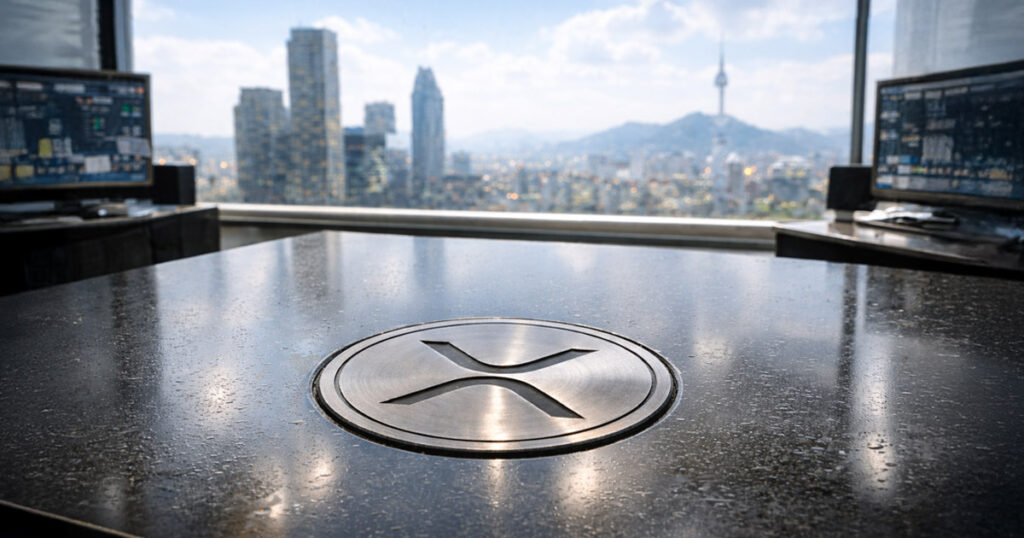
XRP has become South Korea’s default trading chip, overtaking Bitcoin and Ethereum to dominate the country’s high-speed retail market.
While institutional capital around the world generally gravitates toward Bitcoin as a store of value, South Korea’s trading patterns tell a different story.
Data from the country’s largest exchanges reveals that when the market heats up, domestic traders consistently prioritize XRP for its liquidity and speed. This preference is a structural anomaly that has defined the local retail playbook for 2025.
Dunamu, the operator of the dominant exchange Upbit, listed XRP as the platform’s most traded asset for the year, placing it ahead of the two largest cryptocurrencies by market capitalization.


Notably, the pattern repeats itself on Bithumb, the country’s second largest, where market data places the XRP/KRW pair second in volume share, behind only the USDT stablecoin pair.
This aligns with a broader national trend in which altcoins account for between 70% and 80% of trading volume on national centralized exchanges, a figure that far exceeds the global average of approximately 50%.
Why do South Koreans prefer XRP?
The “why” behind this predominance lies in the difference between conviction and utility.
The South Korean market is optimized for short-term decisions rather than “buy and hold” strategies. In this environment, the best asset is not necessarily the one with the strongest store of value thesis, but rather the one that performs the cleanest as a tool for speculation.
This is because the country’s local infrastructure rewards this specific utility.
Korea’s major exchanges, such as Upbit, rely on spot trading in South Korean won (KRW). When traders want to express an opinion about the market, they rarely turn to illiquid assets. They become assets that remain tradable during surges.
XRP offers large order books, tight spreads, and low execution friction. It has become the “ergonomic” choice for a retail user base trained to treat it as a core rotation pair.
This utility is essential at 9am, which Upbit identifies as its busiest trading time. As the workday begins, liquidity increases in the market and traders need an asset that can absorb the morning surge without coming to a standstill.
XRP constantly serves as the default vehicle for this liquidity, functioning more like a high-speed train for capital than an investment.

Volatility replaces leverage
Meanwhile, structural constraints within the country have also forced speculative energy into XRP.
Cryptocurrency research firm Tiger Research noted that significantly more capital flows into foreign currencies than remains in domestic markets.
This is largely because these investors are looking for derivative products that are not available in their countries. In particular, South Korea’s domestic exchanges mainly offer spot trading.
That restriction creates a divided market, with traders seeking leverage abroad. This means that those who remain on national platforms must manufacture their own leverage by trading assets with high volatility (or “beta”).
XRP occupies a “sweet spot” for this demographic because it exhibits enough volatility to generate significant short-term returns while maintaining enough liquidity to allow traders to exit positions quickly. Therefore, it effectively serves as an indicator of leverage in a spot-only market.


Furthermore, market psychology amplifies this behavior even further.
Many South Korean traders missed the early phases of exponential growth of Bitcoin and Ethereum. Looking to replicate those life-changing returns, they have aggressively turned to altcoins like XRP to capture similar advantages.
This pursuit of high-growth assets has historically led domestic traders to drive euphoric rallies in the cryptocurrency market, with Korean investors repeatedly benefiting from short-term trades in low-cap, high-volatility assets.

The ‘XRP Army’ Pit
Beyond the mechanics of the market, preference is supported by an exceptionally intense community culture.
Tatsuya Kohrogi, senior ecosystem growth manager at Ripple, recently characterized South Korea’s XRP community as “next level,” highlighting an intensity of participation that surpasses that of other major regions.
This fervor is a natural consequence of the country’s high penetration rate. Reports indicate that more than 7 million South Koreans (approximately 15% of the total population) are now registered on local exchanges.
This density created a distinctive social momentum that consistently boosted XRP’s price performance last year. In particular, cryptocurrency analyst Dom pointed out several cases where Upbit’s purchasing power surpassed that of global heavyweights like Coinbase and Binance.
The pattern shows that XRP traders are not just trading the asset; they also constantly appear to defend him on their local platforms.

Institutional bridge
This intense retail engagement is beginning to bring institutional infrastructure into its orbit.
While the market preference for XRP began as a speculative habit, changing global narratives and local developments are turning it into a structural feature.
For years, XRP was at risk of a US regulatory crackdown, but that cloud has lifted. The US Securities and Exchange Commission (SEC) ended its lawsuit against Ripple in August 2025, and since then, major financial firms such as Franklin Templeton have announced ETFs focused on XRP.
This global shift in legitimacy is now being reflected in national infrastructure improvements tailored to the unique makeup of Korea’s market.

Recognizing the depth of the local XRP market, regulated entities are taking steps to support it.
BDACS, one of only four licensed cryptocurrency custodians in South Korea, is actively bridging the gap between blockchain technology and traditional financial institutions.
The company has collaborated with Ripple to provide digital asset custody services for tokenized securities, including stablecoins such as Ripple USD (RLUSD) and, notably, XRP itself.
By creating custody solutions for the asset that dominates retail billing, companies like BDACS are validating the market’s choice.
Therefore, the narrative surrounding XRP has shifted from being a “speculative tool” to one that is becoming institutionalized.