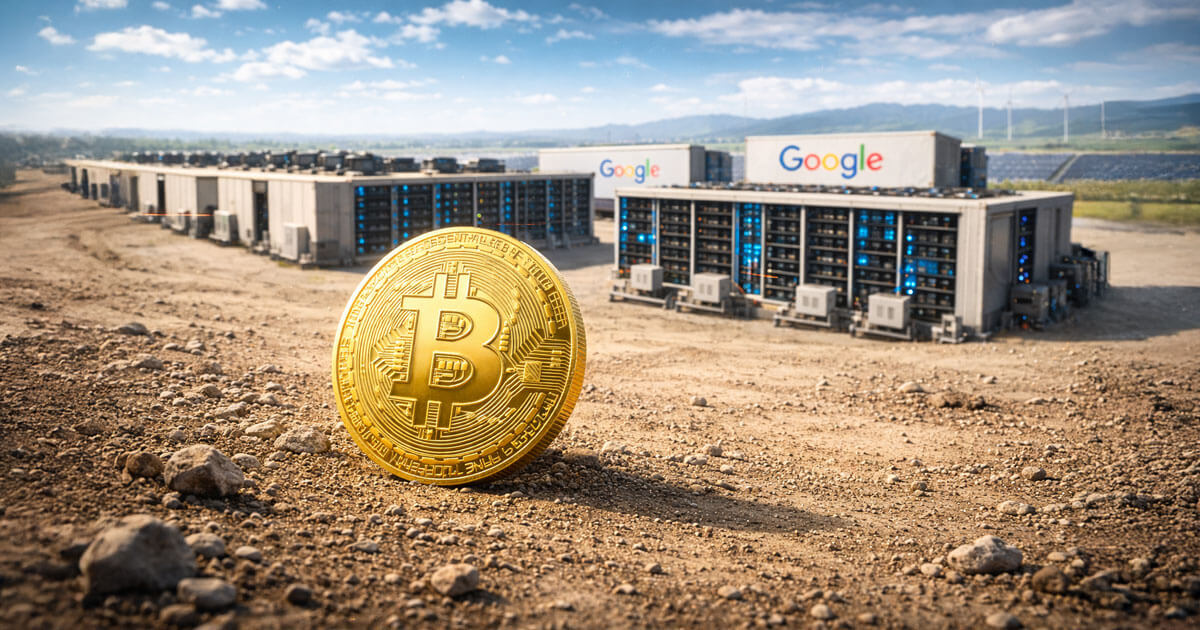
Search engine giant Google has become the quiet architect behind Bitcoin miners’ rapid pivot to artificial intelligence (AI).
Instead of acquiring mining companies, the Alphabet-owned company has provided at least $5 billion of disclosed credit support behind a handful of BTC miner AI projects.
While markets often frame these announcements as technology partnerships, the underlying structure is closer to credit engineering.
Google’s backing helps recast these previously unqualified mining companies as counterparties that lenders can treat as infrastructure sponsors rather than pure commodity producers.
The mechanism for these agreements is quite simple.
BTC miners provide energized land, high-voltage interconnections, and frame buildings. Fluidstack, a data center operator, signs multi-year leases with these companies for “critical IT load,” the power delivered to AI servers.
Google then underwrites Fluidstack’s leasing obligations, giving risk-averse commercial banks room to underwrite the projects as infrastructure debt rather than speculative crypto financing.
Google’s support
TeraWulf set the structural precedent at its Lake Mariner campus in New York.
After an initial phase, the mining company announced a massive expansion, raising the total contracted capacity above 360 megawatts. TeraWulf values the deal at $6.7 billion in contracted revenue, potentially reaching $16 billion with extensions.
Crucially, the terms of the deal indicate that Google increased its backing to $3.2 billion and increased its stake derived from guarantees to approximately 14%.
Notably, Google’s role was also evident in Cipher Mining’s AI pivot.
Cipher Mining had secured a 10-year, 168-megawatt AI hosting deal with Fluidstack at its Barber Creek site.
While Cipher markets this as roughly $3 billion in contracted revenue, the financial driver is Google’s agreement to back $1.4 billion of lease obligations.
In exchange for this credit coverage, Google received collateral convertible into approximately a 5.4% equity stake in Cipher.
Cabin 8 Corp. expanded the model further on December 17, revealing a 15-year lease with Fluidstack for 245 megawatts of IT capacity at its River Bend campus in Louisiana.
The contract has a total value of 7 billion dollars. Market sources and company disclosures confirm that JP Morgan and Goldman Sachs are structuring financing for the project, a feat that was only possible because Google “financially backs” the lease obligations.
Why AI Leases Outperform Bitcoin Margins
The structural turn of these miners responds to the deterioration of the mining economy.
CoinShares data puts the average cash cost to produce 1 BTC among publicly traded miners at approximately $74,600, with the total cost including non-cash items such as depreciation closer to $137,800.
With BTC trading around $90,000, margins for dedicated miners remain compressed, leading boards to look for more stable revenue streams.
That pursuit now points to AI and high-performance computing. CoinShares reported that public miners have announced more than $43 billion in AI and HPC contracts over the past year.
Through these deals, BTC miners are in a better position with financial institutions because banks can take out a 10- or 15-year lease of AI capacity as recurring income and benchmark it against debt service coverage ratios.
Bitcoin mining revenue, by contrast, moves with network difficulties and block rewards, a pattern that most institutional lenders are reluctant to anchor themselves in.
However, Google’s role closes this gap. As a credit enhancer, it reduces the perceived risk of projects and allows miners to access capital closer to that of traditional data center developers.
For Google, the structure improves capital efficiency. Instead of bearing the full cost of building data center structures or waiting in interconnection queues, secure future access to compute-ready power through Fluidstack. It also preserves the upside option through equity guarantees in the miners.
Operational risks and counterparty chains
Despite the financial logic, operational execution carries different risks.
Bitcoin miners have traditionally optimized for the cheapest and most easily constrained energy they can get. AI customers, by contrast, expect data center-level conditions, including strict environmental controls and rigorous service level agreements.
Therefore, transitioning from “best effort” mining to near-continuous reliability requires an overhaul of both operational culture and physical infrastructure. If cooling retrofits go over budget or interconnection upgrades face delays, miners will face contract breaches rather than simple opportunity costs.
Furthermore, the structure introduces a significant concentration of counterparties.
The economic chain depends on Fluidstack acting as an intermediary. Cash flows depend on Fluidstack’s ability to retain AI tenants and, ultimately, Google’s willingness to honor the support for more than a decade.
If the AI hype cycle cools or tenants force lease renegotiations, this chain creates a single point of failure. Miners are effectively betting that Google will remain the ultimate backer, but legal resources flow through the middleman.
Risks
The broader implications of these agreements go beyond project financing and encompass competition policy and Bitcoin’s long-term security budget.
By relying on credit backing rather than direct acquisitions, Google can add access to energized land and energy, the scarcest inputs in AI development. This approach avoids the type of merger review that would trigger a large asset purchase.
However, if this template spreads to multiple campuses, critics could argue that Google has created a kind of “virtual utility.” It wouldn’t own the buildings, but it would still determine who can deploy large-scale computing on those networks.
As a result, regulators may come to question whether control over long-term AI capacity, including through leasing, merits closer antitrust scrutiny.
For Bitcoin, the trade-off is simple. Every megawatt diverted from mining to AI reduces the power reserve available to protect the grid.
The market once assumed that hashrate would follow price almost linearly as more efficient platforms and more capital came online.
Therefore, if the most efficient operators systematically redistribute their best sites into AI contracts, hash rate growth becomes more limited and more costly, leaving a greater proportion of block production in the hands of stranded or lower quality energy assets.