



Ethereum is trying to stabilize above the $3,100 level after failing to break the $3,400 resistance, as the broader crypto market struggles to regain momentum. While the bulls managed to defend key support in recent sessions, the price action remains fragile and highly reactive, with sellers continuing to appear on rallies. ETH is stuck in a tight range and traders are watching closely to see if this pullback turns into a deeper correction or simply a reset before the next bullish move.
Related reading
A report from Arab Chain highlights that Binance data points to a sensitive phase for Ethereum in early 2026. According to the analysis, ETH is trading near the $3,200 zone, but market flow conditions remain tilted downwards.
The Cumulative Order Flow (CVD) indicator stands at approximately -3.676, suggesting that net selling pressure continues to dominate near-term activity. In simple terms, more aggressive sell orders than buy orders are coming into the market, even as prices attempt to maintain recent levels.
This divergence between price stabilization and negative flow reflects a market that is not collapsing, but is also not yet attracting strong demand. As Ethereum defends support, the next test will be whether buyers can reclaim $3,300 and challenge the $3,400 ceiling again, or if weakness drags the price towards deeper support zones.
Arab Chain notes that although Ethereum’s CVD remains negative, the relationship between price and liquidity flows is not completely broken. According to the report, the 30-day correlation between ETH price and CVD stands near 0.62, which is a relatively constructive reading. This pattern suggests that price action partially align with volume behavior, although liquidity currently leans towards the sale instead of a new purchase.
In other words, Ethereum is not trading in a vacuum (flows are still important) and the market is reacting in a way that reflects the actual positioning.
From a broader perspective, ETH’s gradual fall to its current levels indicates a correction phase following its previous rise. Historically, this is the type of environment where short-term investors take profits and reduce their exposure, while larger players begin to rebalance their portfolios and slowly rebuild their positions. Instead of an immediate trend reversal, the market often moves into sideways price action as both sides test liquidity.
The key issue is that countervailing duties remain negative, meaning that demand has not yet become strong enough to reverse the short-term flow structure. However, Ethereum’s ability to hold above the $3,000 level points to underlying support that is limiting the downward acceleration.
This mismatch (weak momentum in volume flows but stable price behavior) often precedes calmer periods of consolidation that can then set the stage for further growth once liquidity conditions improve.
Related reading
EETH Bulls Struggle to Reclaim $3,100
Ethereum is trying to stabilize above the $3,100 level after a strong rejection from the $3,400 supply zone, and the price is now trading near $3,111. The chart shows that ETH is still recovering from the broader downtrend that began after the November crash, but the structure remains fragile as sellers continue to defend every attempt to rise.

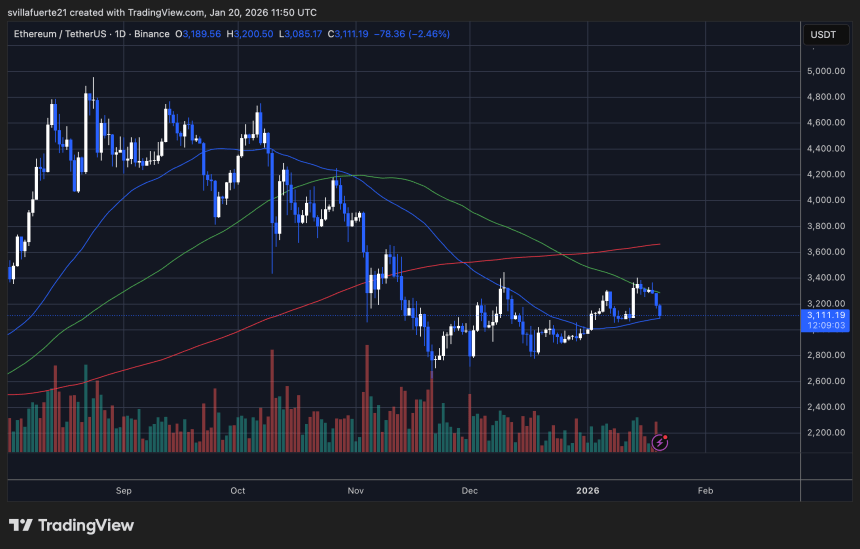
From a technical perspective, the $3,300 to $3,400 region stands out as the key resistance group. Price has repeatedly failed in this area and the latest rejection confirms that it remains an important distribution level. At the same time, Ethereum remains above its short-term moving average, near $3,050-3,100. Suggestive buyers remain active, defending the current range.
Related reading
However, ETH remains capped below the medium-term moving averages, which are trending down and acting as dynamic resistance. This keeps the market in a “recovery within a downtrend” setup unless the bulls can convert those levels back into support. Volume also remained relatively low during the bounce, indicating that the move still lacks aggressive follow-through.
Ethereum seems stuck in consolidation. With $3,000 as the critical floor and $3,400 as the breakout trigger needed to change market sentiment.
Featured image from ChatGPT, chart from TradingView.com