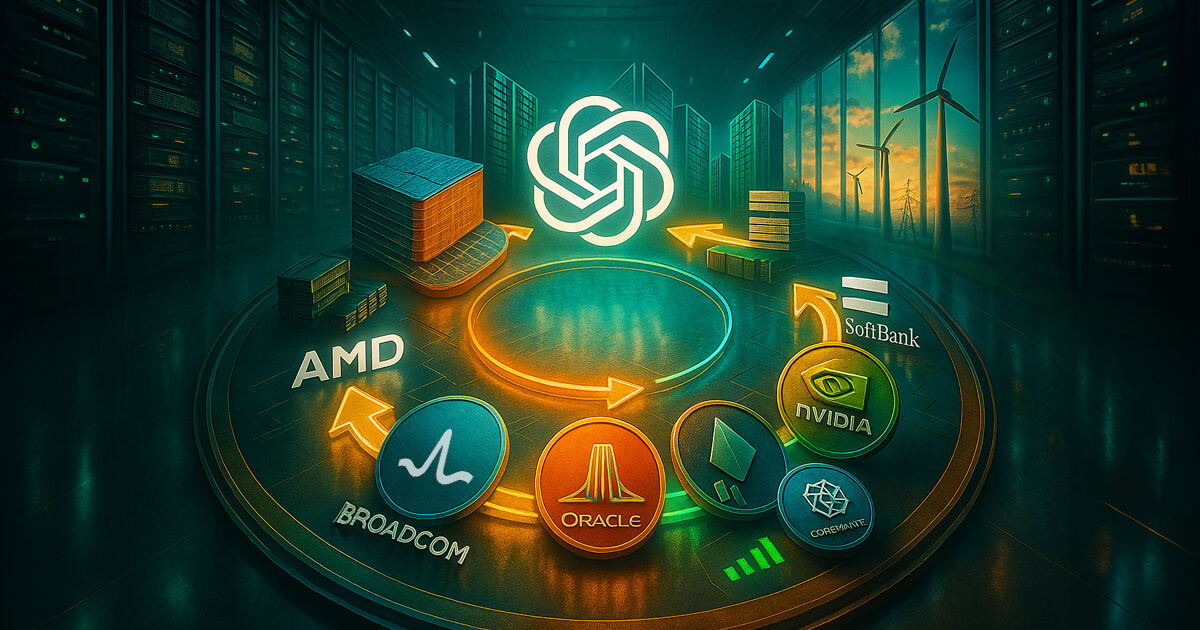

OpenAI has launched a $300 billion hardware expansion that brings together its chip suppliers, financiers, and energy providers into a single feedback loop.
The company has struck multi-year deals with AMD and Broadcom to deliver tens of millions of AI accelerators between 2026 and 2029, deals that together represent about 16 gigawatts of new computing power, enough to rival the total electricity use of some small nations.
AMD will supply 6 gigawatts of Instinct GPUs and has provided capital guarantees to OpenAI tied to performance milestones, while Broadcom will co-design and deploy 10 gigawatts of custom silicon and rack systems over the same period.
Those contracts are in addition to the construction of Stargate with Oracle and SoftBank, a five-site expansion in the United States that refers to more than $300 billion in accumulated spending, the backbone of what may be the largest privately financed infrastructure project in the history of technology.
AI circular economy
The structure of these agreements points to a circular economy pattern in AI infrastructure where capital, equity incentives and purchasing obligations are intertwined between vendors, infrastructure providers and model operators.
The deal with AMD ties future GPU deliveries to milestone-based guarantees that give OpenAI upside exposure to AMD’s stock performance, creating a feedback loop between a supplier’s valuation and a customer’s capacity expansion path.
In parallel, Nvidia disclosed about a 7 percent stake in CoreWeave earlier this year, while CoreWeave expanded its deals with OpenAI by $6.5 billion, bringing the total contract value by 2025 to about $22.4 billion, tying up the capital of a chip supplier, the revenue of an infrastructure lessor, and the computing consumption of OpenAI on the same chain.
Bloomberg also reported on supplier financing loops involving commitments from Nvidia of up to $100 billion related to chip purchases by OpenAI, framing the view of the lawsuit being funded in part by the supplier itself.
A forward-looking vision revolves around three execution gates: utilization, energy and cost curves. On the utilization front, capacity increases announced by AMD, Broadcom and Stargate total double-digit gigawatts through 2029, while enterprise AI revenues must scale to keep cluster occupancy above threshold levels that support attractive returns.
BofA’s October survey recorded that 54 percent of fund managers rated AI as a bubble and cash balances around 3.8 percent, a setup that may amplify swings across the market if the rollout lags behind the delivery schedule.
The concentration of the index adds another macro channel, as the “Magnificent Seven” hovered around a third of the S&P 500’s market capitalization in mid-2025, reinforcing the portfolio’s passive sensitivity to the flow of AI news and changes in capital spending guidelines.
AI energy needs
Regarding energy, the availability of the network and the cost delivered per megawatt-hour determine the feasible pace of expansion of the model.
Goldman Sachs projects that global data center electricity demand will increase by approximately 165 percent by 2030 compared to 2023. This trajectory will push data center operators toward long-term power purchase agreements, on-site generation, and location changes as new clusters come online in 2026-2029.
McKinsey coverage cited in the trade press puts the U.S. trajectory at roughly 25 percent compound growth through 2030, with U.S. data centers potentially consuming more than 14 percent of the nation’s electricity by the end of the decade, increasing planning risk if interconnection queues and permitting times lengthen relative to data deliveries. hardware.
The regulatory path remains fluid, although the UK’s Competition and Markets Authority concluded in March 2025 that Microsoft’s partnership with OpenAI did not qualify for a merger investigation, a baseline that may be revised if new equity-linked supply deals intensify concerns about market power around access and pricing.
Custom silicon is the cost level to watch as Broadcom’s program moves from design to deployment.
If accelerator, network, and rack co-design work generates material performance gains per watt, cost-of-goods inference and training efficiency can reset the unit economics of the circular model toward self-financing cash flows as utilization increases.
Execution risk lies in toolchains, packaging and memory bandwidth, and the timeline begins in the second half of 2026 with a multi-year ramp up to 2029, so financial outcomes for suppliers and operators will follow the speed at which those gains appear in audited margins and contract prices.
The immediate map of commitments is clear, and the conversion of framework agreements into firm purchase orders, disclosed in supplier presentations and press updates, is a short-term control point.
CoreWeave’s funding stream and deals, including corporate actions and the evolution of Nvidia’s ownership, will show how tight the circle between supplier capital, infrastructure capacity and OpenAI’s demand trajectory becomes.
Apple’s system-level integrations expanded consumer surface area in 2024 with privacy terms indicating that OpenAI does not store requests and that IP addresses are hidden, providing a counterpoint to enterprise adoption cycles that tend to advance based on compliance and ROI milestones rather than device scope alone.
The question for portfolio and treasury planning is how announced gigawatts match realized workload growth, regional energy delivery capacity, and cost trajectory through 2028. A practical way to track the shift from circular to sustainable is to combine data center utilization metrics with energy contract coverage ratios and enterprise deal revenue mix. linked to use.
If those measures improve as second-half 2026 deployments begin, the funding loops built into these deals will serve as bridge capital to a more stable computing economy rather than as a source of correlation risk between vendors, infrastructure providers, and the lab.
| Ability | Couple | First deployments | Objective fulfillment | Grades |
|---|---|---|---|---|
| 6GW | amd | 2H26 | N/A | Milestone-based guarantees of up to 160 million AMD shares, OpenAI beneficiary |
| 10 GW | Broadcom | 2H26 | End of 2029 | Custom racks and accelerators co-designed with OpenAI |
| 4.5–5.5 GW | Oracle, SoftBank | in phases | N/A | Five new Stargate sites in US, partnership language above $300 billion in five years |
The path forward is focused on a 24-36 month period as the first Broadcom systems and first waves of AMD come online, power contracts finalize at Stargate sites, and revenue-supported consumption ramps up across enterprise channels. OpenAI says Broadcom’s launch will end in late 2029.