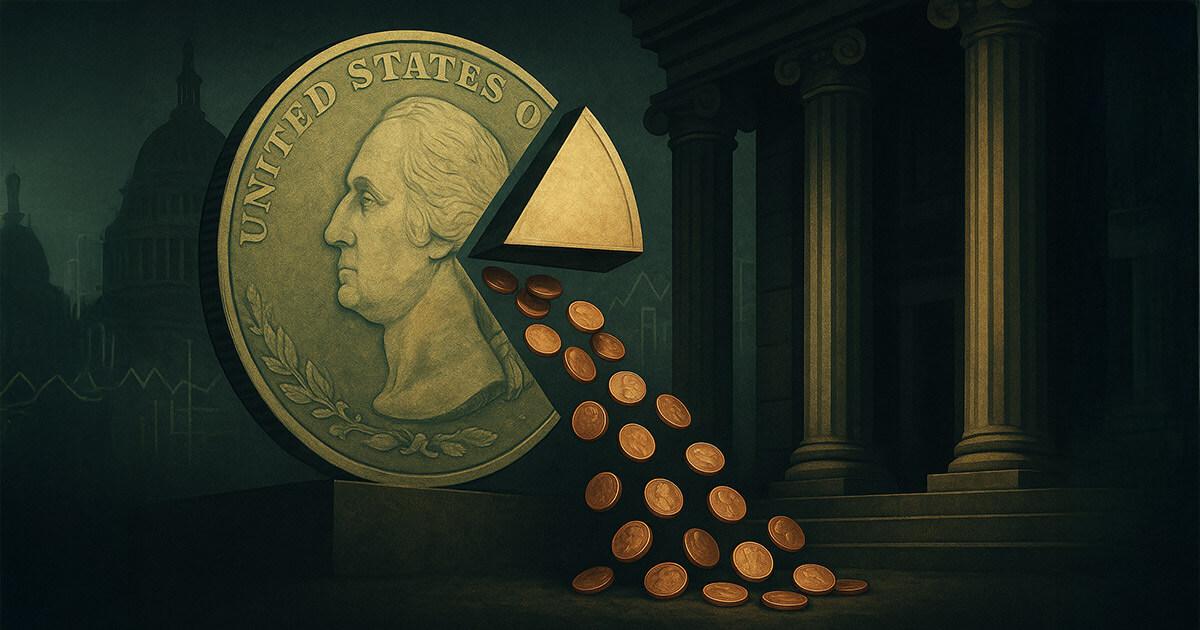

The United States is sitting on a fiscal cliff. With the total debt of the United States that exceeded $ 37.43 billion as of September 2025, the nation faces a historical reality. Almost a quarter of each dollar of taxes that it collects is consumed by attending the interest payments of its debt load.
The relentless march of the US debt
According to the monthly updates of both the US Treasury and the Joint Economic Committee, the national debt has raised to $ 37.43 billion. This marks an increase of $ 2.09 billion in last year.
Interest payments alone for fiscal year 2010 exceed $ 478 billion to date, 17% more than last year, according to CNBC.
It is projected that this expense will represent approximately 23 cents of each dollar raised by the IRS in income. This is an amazing proportion that has increased considerably as global interest rates are normalized after years of quantitative flexibility.
Tariffs: Large numbers, small impact
The last years have seen the United States government accumulate income of record tariffs, especially after a set of new import tariffs taxes under the Trump administration.
These tariffs are expected to reinforce the treasury coffers and could reduce the national deficit by $ 4 billion for a decade.
However, even such unexpected profits barely abolish the mountain of the national debt of the United States, with increasing interest costs overcoming rates collection earnings. The IMF warns that “the scale of the increase in tariff income is very uncertain”, while Eliant Capital published:
“Despite tariff revenues, the deficit for July was $ 291b with the US.

Nothing this train stops
The Macro Lyn Alden analyst has popularized the thesis of “Nothing this train”, a phrase taken from pop culture but now synonymous with the dilemma of the United States debt.
Alden’s analysis argues that persistent deficits and relentless spending make an era of fiscal domain and that substantive tax reform is politically impossible. In his opinion, the relentless accumulation of debt is structurally integrated into the system, and nothing more than a paradigm shift (such as hard money) can break the cycle. Alden told Slate Sundays:
“Simply structurally, it is [U.S. debt] Growing above the goal almost without any way of stopping it. “
According to the Peterson Foundation, interest payments are now the third largest expenses for the federal government. They exceed almost any other program, except Social Security and Medicare.
As part of the income, federal interest payments will increase to 18.4 percent by the end of the year, a level not seen since the early 1990s.


5 days to smarter cryptographic movements
Learn how professionals avoid the coil, detect the first internal steps and capture Alfa, before it is too late.
Brought to you by crypt
As interest payments consume increasing actions of federal income and traditional remedies such as tariffs and expenses of expenses are insufficient, the conversation about “hard money” intensifies.
Bitcoin and other crypts are increasingly seen as alternatives of the value store in an era of persistent monetary expansion.
As Alden’s thesis warns, nothing stops this train, and this realization is feeding renewed attention to hard money solutions such as Bitcoin and Gold.
Investors are looking for alternatives such as bitcoin and gold
Both Gold and Bitcoin have seen a strong demand as alternative value stores in the midst of tax concerns and inflationary pressure.
In mid -September 2025, Gold had reached a historical maximum, quoting more than $ 3,600 per ounce, more than 41% year after year.
Some analysts expect the manifestation of gold to continue, projecting prices towards $ 3,800 for the end of the year, since global liquidity concerns lead investors to safe shelters.
Bitcoin, called for many as “digital gold”, trades around $ 115,000, $ 118,000 after recovering from its September minimums about $ 108,000.
While Bitcoin’s price action has been volatile, many analysts, including Lyn Alden, hope to see at least $ 150,000 at the end of this cycle.
As tax pressures increase, these alternatives are increasingly seen as key safeguards in diversified portfolios, at a time when US debt is out of control.